

There Is Nothing Basic About Kihon
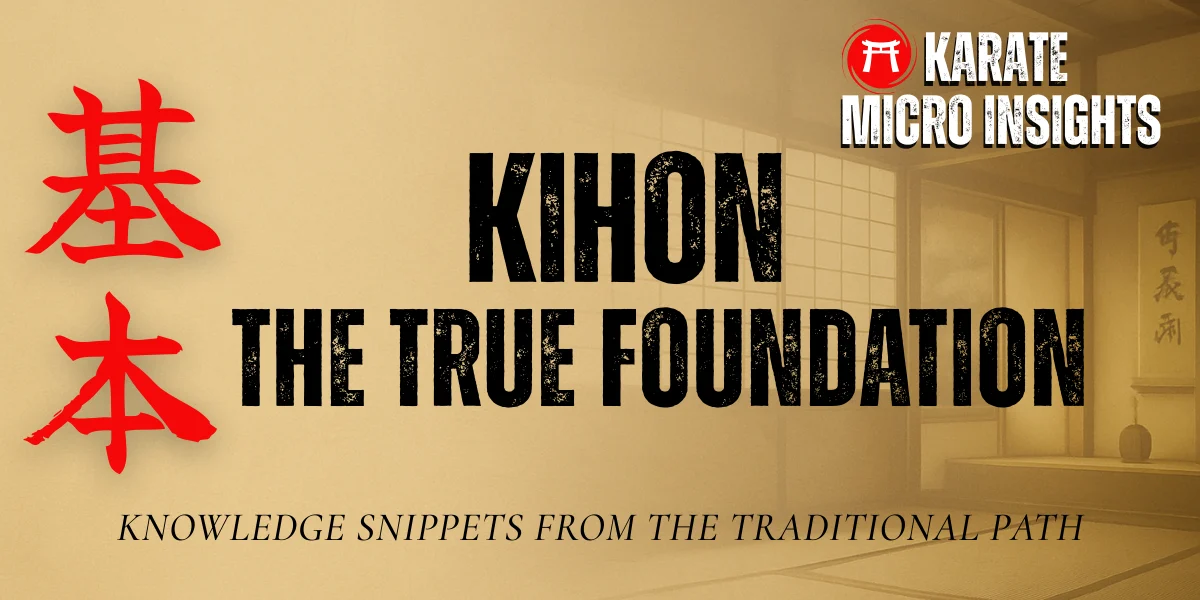
This insight explores Kihon fundamentals — 基本 (Kihon) — the classical Japanese term often translated as “basics,” but more accurately understood as foundation. In traditional karate, Kihon is not a collection of simple techniques; it is the structural base that shapes posture, movement, breathing, and intent. Everything that follows — kata, bunkai, and application — is informed by the quality of one’s Kihon.
Karate Micro Insights offer focused, bite-sized explanations of key principles, terms, and philosophies in traditional karate. Each insight explores a single concept — drawn from dojo experience, Japanese terminology, and timeless martial values.
This article is part of the Karate Knowledge Vault — a curated collection of standalone educational entries designed to inform, inspire, and deepen your understanding of karate, one insight at a time.
Kanji Breakdown
Kanji: 基本 (Kihon)
Pronunciation: /kee-hon/
Literal Meaning: Foundational principles; the underlying base from which something is built.
Breakdown:
- 基 (ki) – foundation, base, groundwork
- 本 (hon) – origin, root, source
Context in Karate
In many dojos, Kihon is casually referred to as “the basics” — something to get through before moving on to kata or kumite. But this misunderstanding creates a problem.
When Kihon is seen as basic, it is often rushed, repeated without thought, or mentally dismissed once a student advances in rank. The focus shifts to the quantity of technique rather than the quality of execution.
In reality, Kihon is not something you outgrow. It is something you return to — again and again — refining structure, balance, timing, and intent as understanding deepens.
At a foundational level, Kihon teaches practitioners to:
- Maintain composure and awareness within fundamental movement
- Seek efficiency through precision rather than speed
- Balance physical technique with mental discipline
- Accept repetition as a path to deeper understanding
True Kihon is not something you move beyond — it is something you continually refine.
Application and Insight
Every aspect of karate is built on Kihon:
- Develop calm focus and control through repetition
- Move efficiently with correct structure and alignment
- Generate power through balance, timing, and breath rather than force
- Cultivate discipline and restraint before application
- Strong Kihon fundamentals provide the clarity and structure that allow karate to function under pressure.
True Kihon is not about performing techniques; it is about building the foundation that makes all karate effective.
Real-World Parallel
Foundations are rarely visible once a building is complete — but they determine whether that structure stands or collapses.
Kihon works the same way.
The more advanced the karate, the more precise and intentional the fundamentals must become.
Reflection
If your Kihon feels “basic,” the question is not whether it is simple, but whether you are truly present in it.
Depth in karate is not found by adding more techniques. It is found by understanding the ones you already practice.
Train your Kihon as a foundation, not as preparation.
For senior practitioners especially, revisiting Kihon fundamentals is not a step backward, but a return to clarity. Precision, restraint, and intent are refined here — long before they appear in kata or application.
Because there is — quite simply —
Nothing basic about Kihon.
Explore Further
▶️ Watch the Insight: (Video Edition Arriving Shortly)
Every Insight receives a dedicated video episode. The Video Edition of this topic is currently in final preparation.
Community Connection
How do you approach Kihon in your own training or teaching?
Is it something you revisit deliberately, or something that has changed meaning for you over time?
💬 Join the discussion inside the Karate Explained Community, and share how Kihon shapes your understanding of karate.
Share Now & Help Others Learn!
Enjoyed this article? Continue your journey inside the Karate Explained Community.
Join free to access discussions, early releases, and member-only insights — all designed to support your growth on and off the dojo floor
Forever a Student. Forever improving