Kime — The Moment of Decision
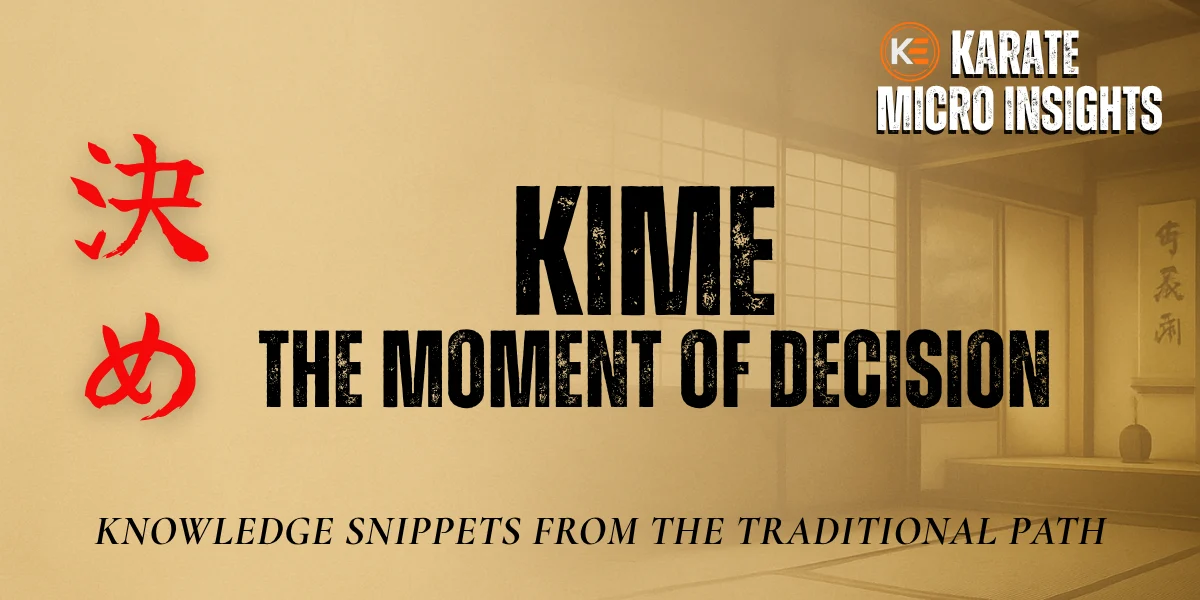
Kime in karate is often associated with power, but this insight explores 決め – Kime as something deeper — the decisive completion of technique, where body, breath, timing, and intent come together with purpose.
A focused look at a key karate term, informed by dojo practice, Japanese terminology, and the deeper intent behind traditional training.
Kanji Breakdown
Kanji: 決め (Kime)
Derived from the verb: 決める (kimeru)
Meaning: to decide, to determine, to settle, to fix
Kime in karate is often translated as focus, decision, or decisive completion. While it is commonly associated with power, the deeper meaning points toward the moment where technique, body, breath, timing, and intent come together with clear purpose.
A useful question sometimes arises when students begin exploring Japanese terminology: does kime always mean the same thing in martial arts?
The answer depends on the kanji and the context. In karate, kime is commonly written as 決め, from 決める, meaning to decide or determine. This supports the idea of decisive completion.
However, Japanese martial arts sometimes use the sound kime with different kanji. In some compound martial arts terms, such as hiji-kime-osae — elbow-locking control — kime may be written as 極め, carrying the sense of fixing, locking, or applying something decisively.
The pronunciation may be the same, but the kanji and context can slightly change the meaning. This is why it is important to look beyond the sound of a term and consider how it is being used.
In karate practice, kime is not simply about tensing the body, stopping sharply, or making a technique look strong. It is the moment where hesitation ends and the technique is expressed decisively.
Why Kime in Karate Matters
Understanding kime changes how you approach technique. Instead of focusing only on how powerful a movement looks, you begin to recognise whether the movement has arrived with structure, timing, breath, and intent.
A common misunderstanding is that kime means constant tension. Students may try to “show kime” by tightening the body throughout the whole movement or freezing at the end of a technique.
This can create the appearance of power, but it can also restrict breathing, slow movement, and make technique feel forced. True kime is brief, precise, and functional. It appears at the correct moment, then releases.
When understood correctly, kime becomes the moment movement becomes decision. The body is organised. The breath supports the action. The mind is committed. The technique arrives with purpose.
3 Key Insights into Kime
- Kime is not simply tension. Tension may appear briefly at the point of completion, but it is not the whole meaning of the concept.
- Kime connects body, breath, and intent. It is not produced by the arm or leg alone. Posture, stance, hip movement, breathing, timing, and mental focus all contribute.
- Kime is the expression of decision. It is the point where the practitioner commits fully to the action, without hesitation or uncertainty.
Applying Kime in Practice
Kime is present across kihon, kata, kumite, and practical application. It helps karateka develop not only stronger technique, but clearer technique.
- Kihon — Kime teaches technical completion. The student learns how posture, alignment, breathing, and intent support the technique at the moment it arrives.
- Kata — Kime helps reveal moments of decision, control, impact, or transition. It gives kata punctuation without turning it into a series of frozen poses.
- Kumite — Kime is not about looking powerful. It is about acting at the right moment, with the right distance, timing, and purpose.
- Application — Kime should remain functional. A technique must complete with purpose, but the body must also remain ready to continue.
Key Takeaways
- Kime is not just power — it is decisive completion.
- In karate, kime is commonly written as 決め, from 決める, meaning to decide or determine.
- Some martial arts terms may use the same sound with different kanji, such as 極め, depending on the context.
- Kime is not constant tension; it appears at the correct moment, then releases.
- True kime brings together body, breath, timing, technique, and intent.
- In karate, kime is the moment movement becomes decision.
The next time you train, consider whether your kime is simply tension, or whether the technique truly arrives with clarity and purpose. In karate, the strongest technique is not always the one that looks the hardest. It is the one that arrives with decision.
Train with thought. Move with purpose. And always remember — you are forever a student.
Quick Tip
Looking for more detailed explanations on terminology? Explore the in-depth guide and expand your understanding of the language that shapes karate practice.
Continue your journey inside the Karate Explained Community.
Join free to access discussions, early releases, and member-only insights — all designed to support your growth on and off the dojo floor.
Community Connection
How do you currently understand kime in your karate — as power, tension, focus, or decision?
Think about your recent training: are you using kime to make technique look strong, or to complete the technique with clarity, breath, timing, and purpose?
👉 Join the discussion inside the Karate Explained Community and share your perspective.